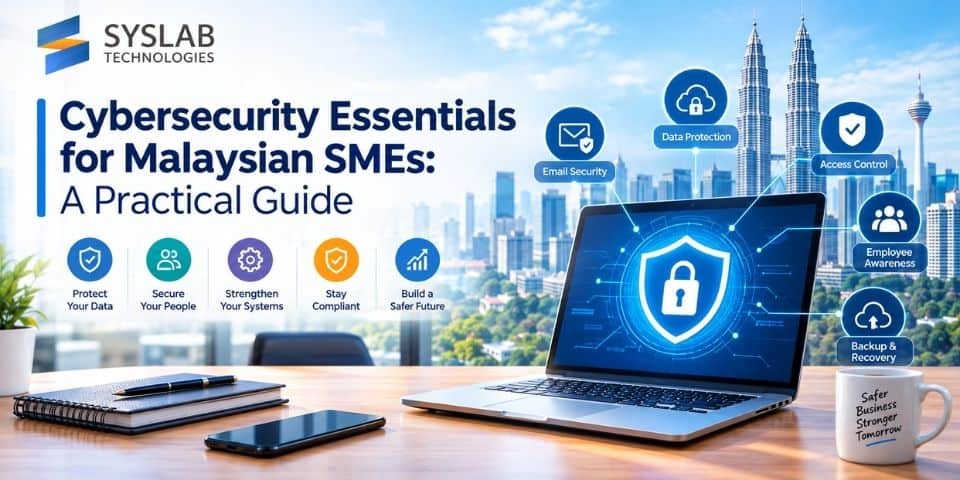
SMEs often assume cyberattacks target big corporations — but attackers frequently prefer smaller businesses precisely because they have weaker defences and less dedicated IT staff. In Malaysia, where PDPA compliance and growing digital operations (e-invoicing, cloud ERP, online payments) mean more sensitive data flowing through business systems than ever, basic cybersecurity hygiene isn’t optional anymore. This guide covers the cybersecurity for SMEs practical essentials, without requiring an in-house security team.
Why SMEs Are Frequent Targets, Not Overlooked Ones
- Weaker defences: Fewer dedicated IT security resources make SMEs easier targets than large enterprises with security teams.
- Valuable data anyway: Customer records, financial data, and supplier information all carry ransom or resale value regardless of company size.
- Supply chain access: Attackers sometimes target smaller vendors specifically as a stepping stone into larger partner or client networks.
- Underinsured against downtime: A ransomware attack that halts operations for even a few days can be financially devastating for a business without the cash buffer larger companies have.
The Core Threats Malaysian SMEs Actually Face
1. Phishing emails
Still the single most common entry point for breaches — a convincing fake invoice, delivery notice, or “urgent” request from a spoofed executive email tricks a staff member into clicking a malicious link or transferring funds.
2. Ransomware
Malicious software that encrypts business data and demands payment for its release — often entering through a phishing link or an unpatched software vulnerability.
3. Weak or reused passwords
Employees reusing the same password across business and personal accounts means one leaked personal account can compromise business systems.
4. Unpatched software and legacy systems
Older software (including unsupported legacy applications) that no longer receives security updates becomes an increasingly easy target over time.
5. Insecure cloud/ERP access
As more Malaysian SMEs move to cloud-based ERP and other cloud systems, weak access controls (shared logins, no multi-factor authentication) become a growing risk surface.
A Practical Cybersecurity for SMEs Checklist
1. Enable Multi-Factor Authentication (MFA) everywhere possible
This single step blocks the majority of account-takeover attempts, even if a password is compromised. Prioritise email, accounting/ERP systems, and any system holding customer data.
2. Train staff to recognise phishing
Most breaches start with human error, not a technical failure. Regular, short training — even a 15-minute session covering real examples — meaningfully reduces click-through rates on phishing attempts.
3. Keep software and systems patched
Outdated software is one of the most common and most preventable attack entry points. Establish a routine patching schedule rather than relying on ad-hoc updates.
4. Back up data — and actually test the restore
A backup that has never been tested for restoration isn’t a real safety net. Maintain backups separate from the main network (so ransomware can’t encrypt them too) and periodically confirm they actually restore correctly.
5. Restrict access based on role
Not every employee needs access to every system or dataset. Limiting access reduces the damage a single compromised account can cause.
6. Secure your ERP and financial systems specifically
Financial and operational data is often the most damaging to lose or expose. Confirm your ERP or accounting platform supports role-based permissions and audit logs, not just basic login protection.
7. Have an incident response plan — before you need one
Know in advance who gets notified, what gets disconnected, and how operations continue if a breach happens. Deciding this during an actual incident wastes critical response time.
8. Review third-party and vendor access regularly
External vendors or contractors with system access are a common overlooked risk — review and revoke access promptly when a project or relationship ends.
PDPA Considerations for Malaysian Businesses
Beyond the direct cost of an attack, Malaysian businesses handling personal data have compliance obligations under the Personal Data Protection Act (PDPA). A data breach involving customer information carries both reputational and regulatory consequences, making basic security hygiene a compliance matter as well as an operational one.
Cybersecurity and System Integration Go Together
Security gaps often widen at the connection points between systems — an integration or data flow built without proper access controls can quietly become the weakest link in an otherwise secure setup. When implementing new software, integrations, or ERP systems, security should be planned as part of the architecture, not added afterward.
Getting Started Without an In-House Security Team
You don’t need a dedicated security department to materially reduce risk — most of the checklist above can be implemented through configuration changes and staff training rather than new technology purchases. For businesses running custom or legacy systems, a proper technical review is worth prioritising first, since those systems often carry the highest unaddressed risk.
Syslab Technologies supports Malaysian SMEs with secure system integration, ERP implementation, and legacy application support. Contact us for a practical review of your current systems and access controls.
FAQs
Q: Why do hackers target small businesses in Malaysia?
A: Small businesses are often targeted precisely because they have weaker security defences than large enterprises, while still holding valuable customer, financial, or supplier data worth stealing or ransoming.
Q: What is the most common cybersecurity threat for SMEs?
A: Phishing emails remain the most common entry point for breaches, tricking employees into clicking malicious links or approving fraudulent payments through convincing fake messages.
Q: What is the single most effective cybersecurity step an SME can take?
A: Enabling multi-factor authentication (MFA) across email, ERP, and other critical business systems blocks the majority of account-takeover attempts, even when a password has been compromised.
Q: Do small businesses in Malaysia need to comply with PDPA for cybersecurity?
A: Yes. Malaysian businesses that handle personal data have obligations under the Personal Data Protection Act, meaning a data breach involving customer information carries regulatory as well as reputational consequences.
Q: How often should backups be tested?
A: Backups should be tested for successful restoration on a regular schedule, not just created — an untested backup provides false confidence and may fail exactly when it’s needed most.