
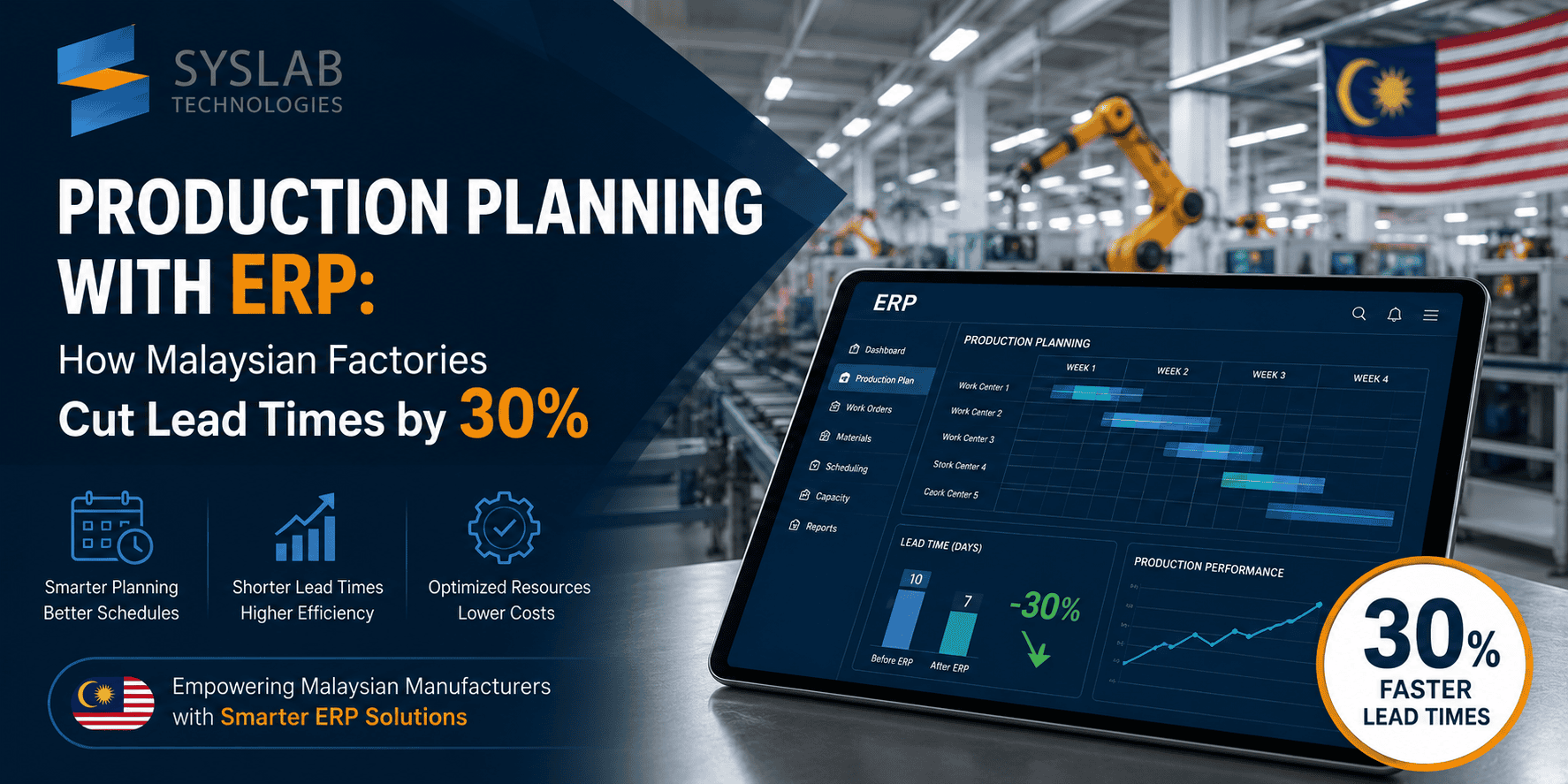
Delivery delays are one of the top reasons Malaysian manufacturers lose repeat business. When a customer waits longer than promised, they do not always complain—they simply place their next order with a competitor. The root cause is almost always the same: production planning done on spreadsheets cannot keep pace with real-world complexity.
This post explains how production planning with ERP works, what Malaysian factories gain from implementing it, and the specific modules that deliver the fastest results.
The Hidden Costs of Manual Production Planning
A production manager working from spreadsheets must manually check stock levels, calculate raw-material requirements, schedule machine time, and communicate job orders to the floor—all before the first unit is produced. When any of those inputs changes (a supplier delays delivery, a machine breaks down, a priority order arrives), the entire plan must be recalculated manually.
The downstream costs:
- Rush procurement at premium prices when materials run short
- Machine idle time when preceding jobs run late
- Overtime costs when delays push work past normal hours
- Customer penalties for missed delivery commitments
How Production Planning with ERP Changes Industry Growth
Material Requirements Planning (MRP)
MRP is the mathematical engine at the heart of manufacturing ERP. It takes your sales orders, maps them to your bill of materials, checks current stock levels, and automatically calculates what you need to buy and when. A task that takes a planner half a day manually is done in seconds—and updated in real time when anything changes.
Finite Capacity Scheduling
MRP tells you what to make. Finite capacity scheduling tells you when each machine can make it. The ERP knows your machine hours, shift patterns, and current work-in-progress queues. It automatically sequences jobs to maximise throughput without creating bottlenecks.
Real-Time Work Order Tracking
Shop floor operators update job status directly in the ERP—via tablet, barcode scanner, or desktop—so management sees real-time production progress. When a job falls behind, the system flags it immediately rather than at the end-of-shift report.
Supplier Lead Time Integration
The ERP stores each supplier’s historical lead time and factors it into purchasing decisions. If Supplier A reliably delivers in 7 days but Supplier B takes 14, the system places orders at the right time to ensure materials arrive before they are needed on the production line.
Measurable Results Malaysian Factories Achieve
Based on industry benchmarks and the results reported by Syslab’s manufacturing clients, factories implementing production planning with ERP typically achieve:
- 25–35 % reduction in average lead time within 12 months
- 15–25 % reduction in raw material inventory (fewer safety-stock buffers needed)
- 40–60 % reduction in emergency procurement events
- Significant improvement in on-time delivery rates
Integration With Quality Control and Finance
Production planning does not exist in isolation. When integrated with quality control modules, the custom ERP automatically schedules inspection checkpoints at each production stage and holds jobs that fail inspection until they are reworked or scrapped—preventing defective goods from reaching customers.
Finance integration means that the moment a production order is completed, the system calculates the actual cost (labour + materials + machine time) and compares it to the standard cost. Variance reports highlight which products or processes are running over budget, enabling rapid corrective action.
How to Get Started: A Practical Roadmap
For Malaysian manufacturers moving from spreadsheets to custom ERP, a pragmatic implementation sequence is:
- Month 1–2: Migrate bill of materials and supplier data; go live on inventory management
- Month 3–4: Activate MRP and purchase order automation
- Month 5–6: Roll out work order tracking and finite capacity scheduling
- Month 7+: Connect quality control, HR, and financial consolidation
Syslab Technologies provides fixed-cost implementation proposals so you know your total investment before a single line of code is written. Learn more about their manufacturing ERP modules or contact the team to discuss your factory’s specific requirements.